MCP vs CLI: Why They Are Not the Same Thing
The AI community says CLI is better than MCP. The data backs it up — for one specific scenario. Here's why that narrative misses the point for enterprise, and what it means for the future of AI agent governance.
TL;DR
CLI is 10-32x cheaper in tokens and hits 100% reliability vs MCP's 72% in benchmarks. But the comparison is a category error. CLI is an invocation mechanism. MCP is an integration protocol. Saying "CLI is better than MCP" is like saying "cURL is better than OAuth." They operate at different layers of the stack, and production architectures need both.
The Debate That's Everywhere Right Now
If you've been following AI Twitter, Hacker News, or the developer blogosphere in early 2026, you've seen this take: "Just use CLI. MCP is overengineered."
Perplexity's CTO announced in March 2026 that they're abandoning MCP internally, citing 72% context window waste. Y Combinator's CEO built a CLI-based setup instead of using MCP. The Scalekit benchmark (75 runs, Claude Sonnet 4, statistically significant at p < 0.05) showed MCP costing 32x more in tokens for simple tasks. These are credible signals from credible people.
We don't dismiss them. But the framing is wrong.
CLI lives at the invocation layer: execute a program, pass arguments, read output. MCP lives at the integration layer: identity, authorization, discovery, audit, structured contracts, cross-organization federation. MCP uses invocation under the hood — it can run over stdio, just like a CLI subprocess — but it adds the integration layer on top: who is calling, on whose behalf, what are they allowed to do, and how do we prove it happened.
CLI has no integration layer. It inherits whatever ambient permissions the shell user has. The agent is the user, with all their permissions, and no attribution of what the agent did versus what the human did.
What the Benchmarks Actually Show
Let's look at the Scalekit numbers honestly. They ran 75 tests across multiple complexity levels:
| Metric | CLI | MCP (Direct) | MCP via Gateway (est.) |
|---|---|---|---|
| Token cost (simplest task) | 1,365 | 44,026 (32x) | ~4,400 (3x) |
| Token cost (complex task) | 8,750 | 37,402 (4x) | ~3,700 (0.4x) |
| Reliability | 100% | 72% | ~99% |
| Monthly cost (10K ops) | $3.20 | $55.20 | ~$5.00 |
Note: CLI and MCP (Direct) columns are measured Scalekit benchmark data. The gateway column reflects estimated projections based on schema filtering, not Scalekit benchmark results.
The 32x cost difference is real — but it measures a specific implementation problem: MCP servers dumping all 43+ tool schemas into context on every turn. With schema filtering via a gateway, the gap shrinks to roughly 3x for simple tasks, and MCP actually becomes cheaper than CLI for complex tasks.
Tools like mcp2cli wrap MCP servers as CLIs and achieve 96-99% token savings. The MCP spec itself is evolving toward lazy tool loading. The gap between CLI and well-implemented MCP is roughly 1.5x, not 32x.
MCP's 28% failure rate in the benchmark came from TCP-level ConnectTimeout failures to GitHub's MCP server — network infrastructure failures, not protocol failures. CLI achieves 100% reliability because it runs local subprocesses. That's a genuine advantage for local tools, but irrelevant for remote services.
Seven Things CLI Structurally Cannot Do
These aren't cases where CLI is "worse." These are architectural impossibilities without building an MCP-equivalent layer on top.
1. Identity-Scoped Authorization
With CLI, the agent inherits the shell user's full permissions. MCP supports per-tool, per-user OAuth 2.1 with PKCE. The agent calling list_issues on behalf of User A gets different results than User B. The server holds the credentials; the agent never sees them.
2. Audit Attribution
When an agent runs gh pr merge via CLI, audit logs show the developer performed the merge. The agent's involvement is invisible. With MCP, every tool call is a structured JSON-RPC message with full attribution: who called what, on whose behalf, when. SOC 2, ISO 27001, and the EU AI Act require this.
3. Cross-Organization Federation
CLI is local to the machine. Making it remote requires SSH, bastion hosts, or VPNs. MCP has native HTTP transport with OAuth — an agent at Company A calls a tool hosted by Company B, scoped to exactly the permissions Company B grants.
4. Selective Tool Exposure
With CLI, the agent has access to every binary on $PATH. An MCP server exposes a declared set of tools and nothing more. Least-privilege access is not optional in regulated industries.
5. Per-Session Tool Scoping
If the agent has gh, it can run gh repo delete as easily as gh issue list. MCP supports allowedTools per session — a "triage" agent gets list_issues and add_comment but not close_issue.
6. Human-in-the-Loop Approval
CLI is fire and forget. MCP supports elicitation, sampling, and hook-based approval workflows. A tool can require human confirmation before execution.
7. Agent Identity in the Call Chain
When an agent uses the gh CLI, the access token identifies the user but never the agent. With MCP, the authorization server includes agent identity in the token exchange. For agent chains, MCP maintains the full delegation chain via an act claim.
The "You Just Reinvented MCP" Argument
Security researcher @yenkel made a devastating structural argument in a viral post (196K views) titled "If you kill MCP, you don't give a s**t about security." His point: for any API to be agent-safe without MCP, you need dynamic client registration, OAuth consent instead of API keys, sensitive action approval, and agent-friendly patterns.
His conclusion: "If you do 1 through 4, APIs are enough. And also congrats, you just reinvented MCP."
This is the core rebuttal. Every path to making CLI or raw APIs agent-safe converges on building the same primitives MCP already provides. The question isn't whether you need these capabilities — it's whether you implement them ad-hoc per service or adopt the protocol that standardizes them.
Where CLI Genuinely Wins
CLI is genuinely superior for a specific, important use case: a developer, on their own machine, using tools they already know, automating their own workflow.
LLMs already know git, gh, kubectl, docker from training data — zero-shot competence with no schema overhead. Local execution is fast and reliable. The developer IS the user, so no identity delegation is needed. This is why Claude Code, Cursor, and Windsurf are so effective.
The error is extrapolating from "CLI is great for a developer on their own machine" to "CLI is better than MCP for AI agents generally." The other 95% of enterprise involves agents acting on behalf of other people, across organizational boundaries, with governance requirements.
Teams Are Already Building This By Hand
The strongest market validation comes from MCP skeptics building workarounds. Teams are building FastAPI and Express scoped proxies with YAML whitelists per service — defining allowed projects, operations, and response fields — because MCP's default tool exposure doesn't meet production requirements.
These solutions work, but they have to be built per service: Jira, Confluence, Google Workspace, Notion, Linear, each getting its own proxy, audit logging, and access control. The ecosystem data reinforces this: 53% of MCP implementations rely on insecure long-lived static secrets. OAuth adoption is at just 8.5%.
This is what Palma solves.
Palma.ai provides this governance layer as a platform: policy-based access control, full tool-call audit trails with agent attribution, MCP gateway with multi-tenant isolation, approval workflows, and a tool catalog with versioning and drift detection. Instead of building bespoke proxies per service, you configure it once for all services.
Adoption Is Accelerating Despite the Narrative
While "CLI is better" dominated tech Twitter in Q1 2026, MCP's actual adoption tells a different story.
| SDK | Weekly Downloads | Monthly Downloads | Dependents |
|---|---|---|---|
| TypeScript SDK | 47.9M/week | ~192M/month | 36,593 projects |
| Python SDK | 50.6M/week | ~161M/month | |
| Combined | ~98.5M/week | ~350M+/month |
Source: npm weekly download stats, March 2026.
For context, React took roughly 3 years to reach 100M monthly downloads. TypeScript took about 4 years. MCP surpassed that in approximately 16 months — and now sits at over 350M monthly. The TypeScript SDK peaked at 13.3M downloads on a single day (March 26, 2026).
Block (Square) reported 75% time savings in developer workflows. Bloomberg adopted MCP org-wide. OpenAI, Google DeepMind, and Anthropic all adopted it. The protocol is now under vendor-neutral governance at the Linux Foundation.
The Zuplo State of MCP Survey (December 2025) found 72% of respondents expect their MCP usage to increase, and 38% say security concerns block wider adoption. Worth noting: Zuplo sells an MCP gateway product, so their respondents skew toward existing MCP users rather than a representative developer sample. But the directionality is clear — and the security concern validates the need for governance infrastructure.
The Bottom Line
Independent analyses from CircleCI, Smithery, Scalekit, and Descope all reach the same conclusion: CLI for the inner loop, MCP for the outer loop.
CLI is an excellent invocation mechanism. MCP is an essential integration protocol. Every problem CLI solves well confirms it's a great invocation layer. Every problem it can't solve confirms the need for an integration protocol with governance on top.
Want to see how governed MCP works in practice?
Talk to us about deploying MCP with enterprise-grade governance: identity, authorization, audit, and cost control from day one.
Read More
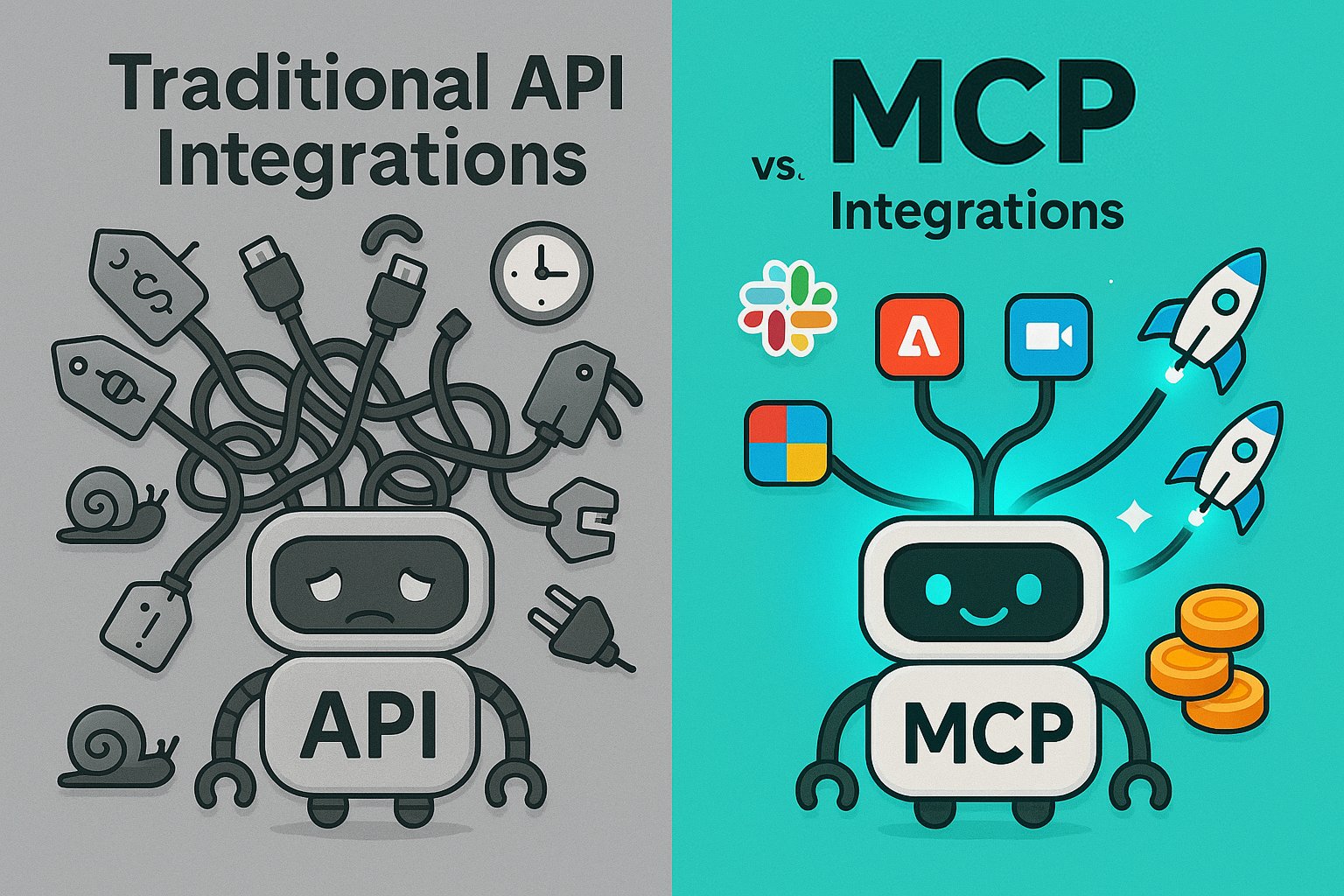
MCP vs API: What Changes for Enterprise Integrations
MCP replaces point-to-point API integrations with one protocol agents discover at runtime. Where each wins, and what it costs to maintain.
How to Give 500 Developers MCP Access Without Losing Control
The enterprise governance playbook for rolling out AI agent MCP connections at scale. Access control, data boundaries, approval workflows, audit trails, and cost tracking — everything you need to unlock MCPs without security, compliance, or budget surprises.
Book a demo
See what governed AI agents look like.
A 20-minute demo on your stack. We'll show Palma working with the agents, tools and identity provider you already run.
- Enterprise security
- Role-based access
- Instant integration