A CIO's Guide to Scaling AI Agents Across the Enterprise
MCP gateways helped enterprises connect models to tools. The CIO challenge in 2026 is different: scaling AI agents across the organization without creating unmanaged risk, compliance exposure, or runaway costs. Palma.ai is the strategic control plane for agent execution.
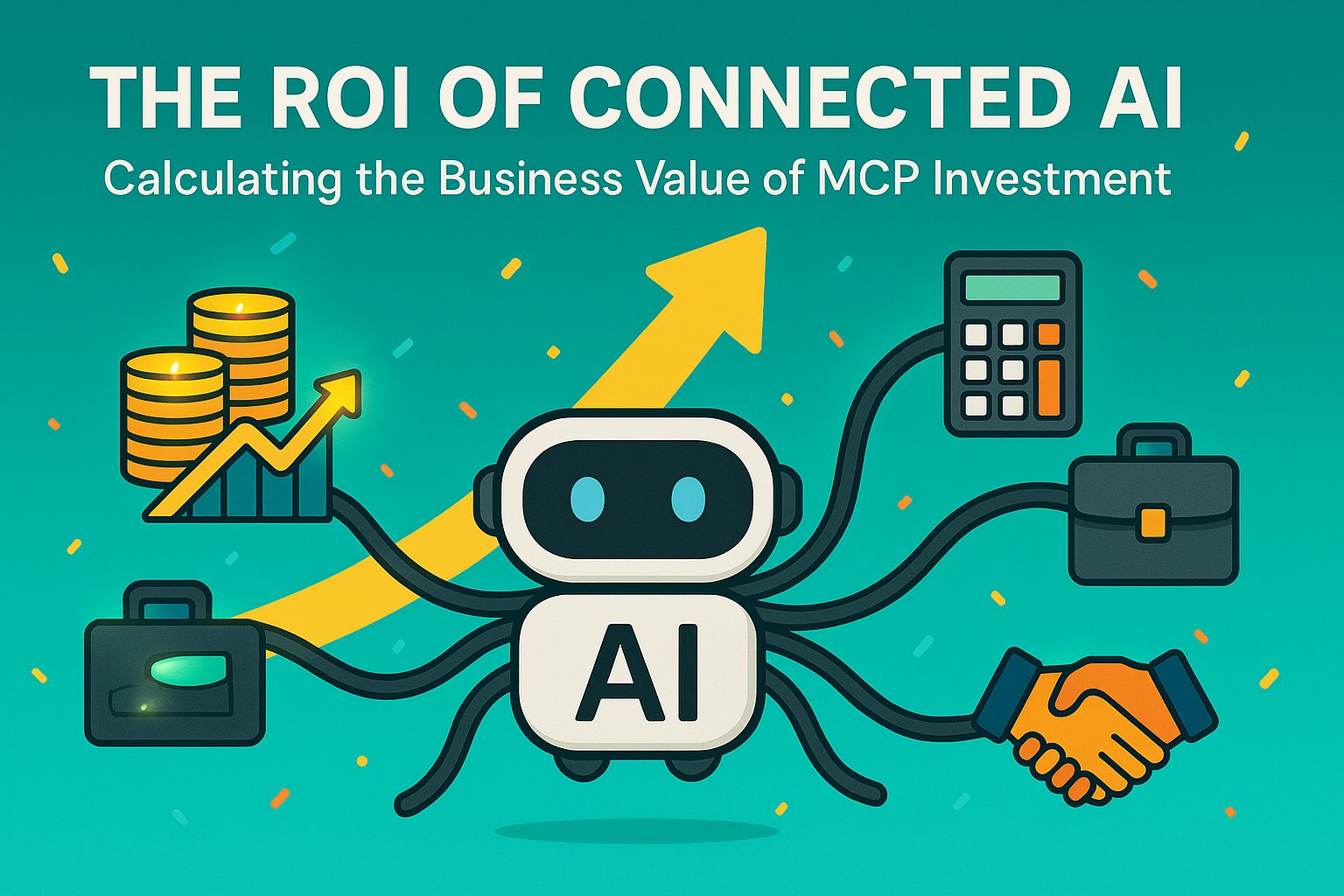
TL;DR: MCP gateways helped enterprises connect models to tools. That was the first chapter. The CIO challenge in 2026 is different: scaling AI agents across the organization without creating unmanaged risk, compliance exposure, or runaway costs. Palma.ai is the strategic control plane for agent execution—turning scattered "agent projects" into a governed enterprise capability with clear accountability, measurable ROI, and a path from pilots to production.
The CIO problem: AI agents are becoming an operating model
Most CIOs are no longer asking whether agents are useful. They are asking whether agents can be trusted as a production operating model.
The inflection point is predictable: a few successful pilots become a wave of departmental automation requests. Within months, "one agent" becomes many agents. That shift changes the nature of the job. It stops being an innovation topic and becomes an enterprise control topic—just like identity, endpoints, cloud spend, or integration platforms did in previous waves.
At scale, the strategic questions are consistent:
- Can we expand adoption without expanding risk faster than we can govern it?
- Can we prove control to auditors, regulators, and internal risk stakeholders?
- Can we keep execution costs and performance stable as usage grows?
- Can we avoid a new generation of Shadow IT—this time powered by agents?
This is why "we connected the tools" is not the same thing as "we have a platform."
What Palma.ai is, strategically
Palma.ai is the governance and execution control plane for enterprise AI agents. We sit between agent fleets and enterprise systems to ensure agent work is approved, accountable, auditable, and economically predictable—across departments and over time.
In CIO terms, Palma.ai turns agent adoption into a platform discipline:
From projects to products
Capabilities that are owned, versioned, and reusable across the org
From access to control
Governance that applies at execution time, not just at connection time
From experimentation to economics
Visibility into cost, performance, and value by team and workflow
The technical mechanisms matter, but they are secondary to the strategic outcome: enterprise-scale trust.
Why gateways are necessary infrastructure, but not a strategy
Gateways are a rational first step. They reduce friction to connect agent clients to tools and standardize authentication patterns. For early teams, this is enough to demonstrate value.
But CIOs are optimizing for the second-order effects of adoption: proliferation, inconsistency, and risk compounding.
A gateway answers: "Can the agent reach the tool?"
A CIO needs: "Can the enterprise stand behind what the agent is doing?"
When adoption accelerates, the gaps appear in the places CIOs feel most acutely:
- Ownership becomes unclear ("who is responsible when this workflow breaks?")
- Policy becomes inconsistent ("why does Sales have a different control model than Finance?")
- Compliance becomes fragile ("can we reconstruct what happened six months ago?")
- Costs become volatile ("why did spend spike, and what did we get for it?")
This is the pivot from infrastructure to orchestration—and from orchestration to enterprise governance.
The strategic shift: building an internal capability economy
The most important scaling decision is what you choose to standardize.
In many enterprises, agent adoption begins by exposing tools: databases, ticket systems, knowledge bases, CRMs. Over time, that creates a sprawling landscape of "agent-to-tool" integrations that are hard to secure uniformly and even harder to govern.
A CIO-grade approach is to standardize capabilities rather than endpoints.
A capability is an internal product: a bounded business outcome (e.g., "financial close validation," "HR onboarding," "customer renewal package") with clear ownership, lifecycle management, and governance embedded.
This has a strategic payoff: it gives the enterprise a way to scale adoption without multiplying risk. Teams can consume approved capabilities instead of creating bespoke integrations—and platform teams can evolve and improve those capabilities centrally.
Trust at scale: predictable execution, not best-effort behavior
CIO trust is not built on demos. It is built on predictability.
In practice, many early agent workflows behave like improvisation: the model decides each step as it goes, reacting to intermediate states with varying quality. That works for experimentation, but it is not a stable foundation for production.
Strategically, Palma.ai's value is that it makes agent execution governable as a repeatable operational unit—more like a controlled workflow than a conversational guessing process. The benefit is not "more engineering elegance." The benefit is enterprise reliability: fewer surprises, more consistent outcomes, and clearer accountability.
If your organization is moving from "assistive agents" to "agents that execute," predictability becomes the new perimeter.
Compliance and audit: governance you can defend, not just describe
CIOs are often caught between two truths:
- The business wants speed.
- Governance requires evidence.
At enterprise scale, the question is not whether you log events. The question is whether you can provide credible proof of control: who initiated an action, what policy applied, what data was accessed, what changed, and why that action was permitted.
Agent systems that rely heavily on unstructured prompting typically struggle here, because too much of "what happened" lives in an opaque chain of interactions. That is a weak posture for regulated environments and a stressful posture even for lightly regulated ones—because internal audit and risk teams will eventually ask for traceability.
Palma.ai is built for governance that stands up to scrutiny. The strategic result is that AI adoption stops being a compliance exception and becomes a controlled program: consistent policy, consistent evidence, consistent accountability.
ROI is not "usage"—it is outcomes with accountable economics
Most CIOs will eventually be asked a blunt question: "Are we spending more on AI than we're getting back?"
Agent initiatives often fail this test because cost and value are measured in different units. Teams show activity ("we ran thousands of tasks"), while finance leadership wants outcomes ("we reduced cycle time," "we eliminated manual rework," "we improved throughput") and governance leadership wants control ("we can prove it was safe").
The strategic requirement is to link agent execution to business outcomes with stable economics. That means being able to attribute cost and performance to departments, workflows, and capabilities—not just to models or token counts.
When you can do that, you unlock a better conversation with the CEO and CFO: AI becomes a portfolio of measurable operational programs rather than a series of experiments.
How a CIO should evaluate Palma.ai: a platform test, not a feature test
The fastest way to assess "platform vs project" is to run a pilot that forces the enterprise realities to show up.
Pick one cross-functional workflow that matters (finance, HR, IT ops, customer operations). Then test for three strategic outcomes:
1) Governance holds under real usage
Not "we added a policy," but "policy is consistently enforced and reviewable."
2) Accountability is clear
Not "the agent did it," but "we know the owner, the lifecycle, and the approval model."
3) Economics are explainable
Not "it ran," but "we know cost-to-outcome, and we can scale without cost chaos."
If those three hold, scaling is a program. If they do not, scaling will become a firefight.
Bottom line
MCP gateways solved connectivity. CIOs need something different: a strategic control plane that turns agent adoption into a governed enterprise capability.
Palma.ai is built for that second chapter—where the organization is scaling agent execution across departments and systems, and the CIO must deliver security, compliance, operational stability, and ROI without slowing the business to a crawl.
Continue the CIO guide series
Ready to assess enterprise readiness?
Book a 20-minute CIO review: we'll map one workflow to governance, accountability, and ROI metrics—and outline what "safe scale" looks like for your environment.
Book CIO ReviewRead More
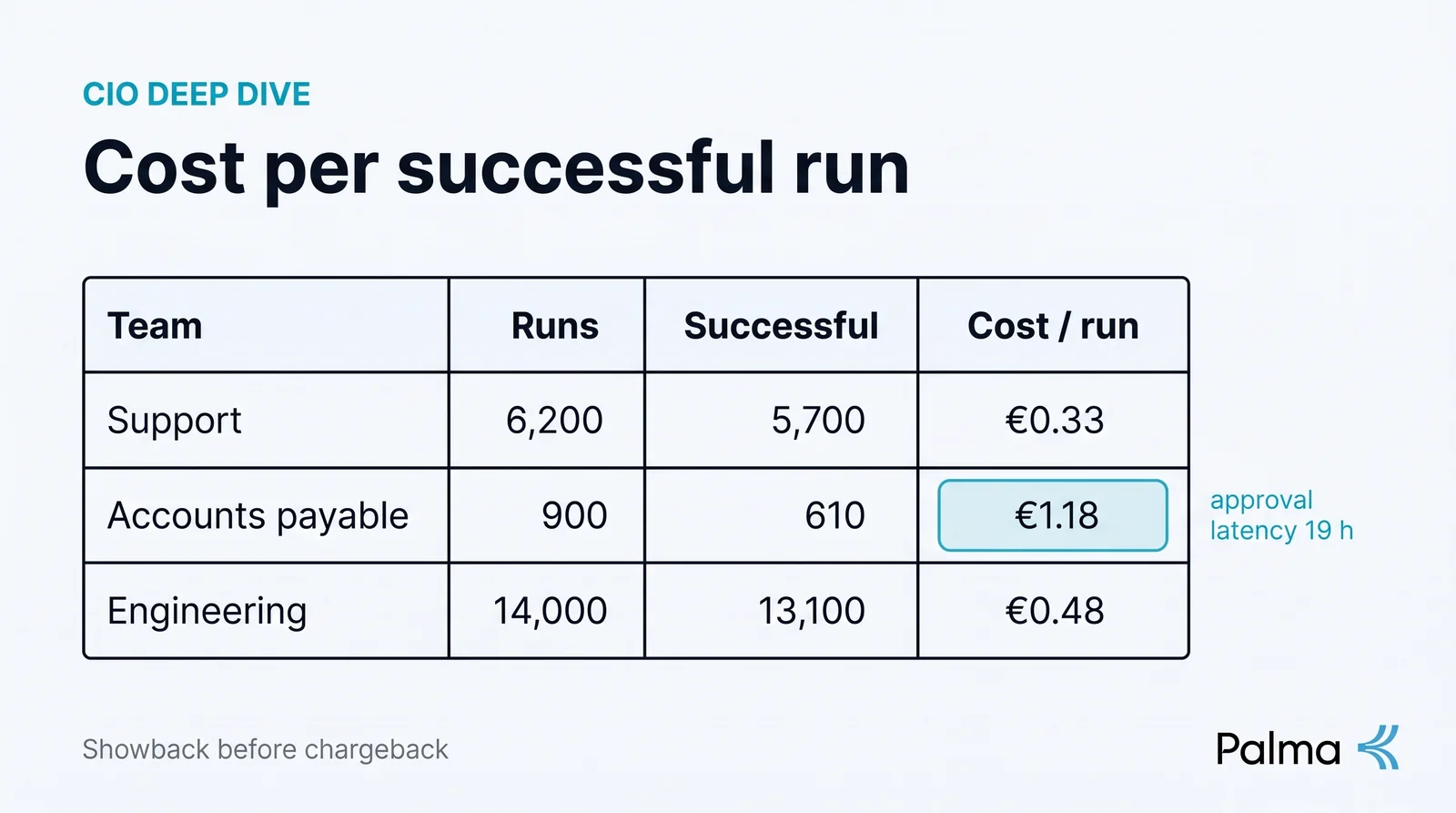
CIO Deep Dive: AI Agent Cost, Reliability and Showback
Why the AI bill cannot be attributed today, the three units that make it attributable, where the waste actually sits, the reliability metrics that belong on the same report, and a worked first showback.
Davos 2026: The Year AI's Execution Gap Became Undeniable
Every executive at Davos is saying the same thing: execution, trust, governance. The AI debate has fundamentally shifted from capability to infrastructure. Here's what that means for enterprise AI in 2026.
Book a demo
See what governed AI agents look like.
A 20-minute demo on your stack. We'll show Palma working with the agents, tools and identity provider you already run.
- Enterprise security
- Role-based access
- Instant integration