2026 AI Agent Predictions From Deloitte, Gartner and IBM
What 12+ analyst reports actually predict for AI agents and tool calling in 2026, summarised — with the points where they disagree.
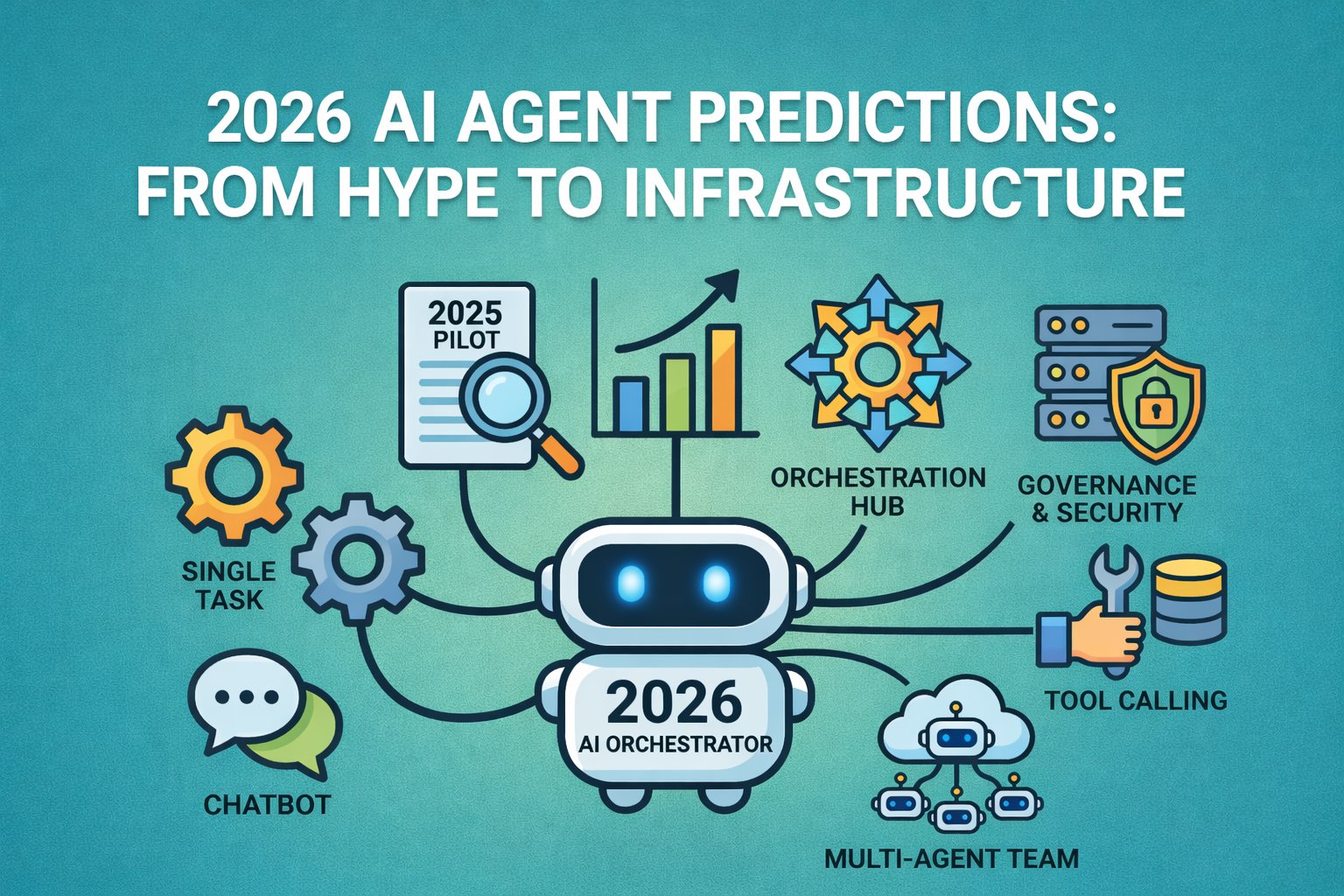
Every major analyst agrees: 2026 is the year AI agents go from experiments to infrastructure. Here is what they are predicting and what it means for tool calling.
We compiled predictions from 12+ analysts, consultancies, and industry voices on what AI agents will look like in 2026.
The consensus is striking. Across Deloitte, IBM, Gartner, Accenture, BCG, and others, the same themes emerge:
- Agents move from pilots to production
- Tool calling and orchestration become critical
- Interoperability standards (like MCP and A2A) gain traction
- Governance becomes non-negotiable
Here is what each source predicts and the patterns that connect them.
The Quick Summary
| Source | Key 2026 Prediction |
|---|---|
| Gartner | 40% of enterprise apps will embed AI agents (up from <5% in 2025) |
| Deloitte | 2026 is the "inflection point" for agentic AI; standards like MCP prevent walled gardens |
| IBM | "Super agents" operate across browser, email, editor without switching apps |
| Accenture | 57% of banks expect agents in risk, compliance, audit, fraud within 3 years |
| RingCentral | 96% of decision-makers say AI agents are essential to competitiveness |
| AnswerRocket | Agents will work 8-14+ hour autonomous shifts by end of 2026 |
| David Sacks | "Coding assistants and tool use will get bigger and bigger this year" |
| TDWI | Agentic AI moves from experimentation to practical deployment |
| Xenoss | Orchestration matters more than model intelligence |
| Frontier Enterprise | Interoperability becomes the competitive differentiator |
David Sacks (All-In Podcast)
Source: All-In Podcast (YouTube)
Prediction: Coding assistants and tool use will be the breakout trend of 2026.
On the All-In Podcast's 2026 predictions episode, investor David Sacks called out the rapid progress in AI tool usage:
"There has been a breakthrough in the last couple of months in terms of these coding assistants... there seems to have been another level of quality achieved just in the last month or so. Part of it is coding, part of it is just tool use. You can download the programs and it has access to your file drive and it can take actions on your computer."
Sacks compared the current moment to the chatbot hype at the end of 2022 going into 2023, except this time it is about agents that do things, not just chat:
"This trend feels to me like chatbots did at the end of 2022 going into '23 where people were really hyped about it but then continued to play out in the next year. I think these coding assistants and tool use will get bigger and bigger this year."
The key insight: the shift from AI that generates text to AI that takes actions on your computer is the 2026 inflection point. This aligns with the broader analyst consensus on tool-calling infrastructure.
Deloitte: The "Inflection Point" for Agentic AI
Source: Technology, Media and Telecom 2026 Predictions
Deloitte calls 2026 an "inflection point" for agentic AI.
Their prediction: businesses will start scaling up multi-agent systems with proper orchestration. This requires standard protocols so agents can communicate with each other and external tools.
Key points:
- Emerging standards like Google's A2A and Anthropic's Model Context Protocol (MCP) aim to prevent incompatible "walled gardens"
- Enterprise workflows will become more modular and agent-driven
- Success depends on orchestration platforms and governance practices
The Deloitte view: without interoperability standards, agent deployments fragment into silos. With them, tool-using agents can work together across the enterprise.
IBM: The Rise of "Super Agents"
Source: The Trends That Will Shape AI and Tech in 2026
IBM experts declare we are "past the era of single-purpose agents."
Their quote: "Agents can plan, call tools and complete complex tasks" now. The 2026 evolution is from standalone assistants to integrated agentic systems.
Key predictions:
- "Super agents" will operate across browser, email, editor, and apps without users juggling separate interfaces
- AI agents will evolve from assistants into AI-orchestrated teams
- Everyday business users will increasingly "compose" their own agents for complex workflows
The IBM framing: 2026 is about moving beyond standalone models to integrated systems that coordinate tools and actions autonomously.
Gartner: 40% of Enterprise Apps Will Embed Agents
Source: Gartner Press Release
Gartner's headline number: 40% of enterprise applications will embed AI agents by end of 2026, up from under 5% in 2025.
That is not incremental growth. That is a phase transition.
The analyst community interprets this as the "microservices moment" for AI: instead of one giant model doing everything, we will have teams of specialized agents orchestrated like services.
Key insight: orchestration is becoming more important than model size or IQ. The new bottleneck is making multiple agents and tools work together.
Protocols like Anthropic's MCP and Google's A2A are compared to an "HTTP for agents," allowing any AI agent to plug into any tool or collaborate with other agents in a standard way.
Accenture / Banking: Agents Scale Enterprise-Wide
Source: Top Trends 2026 via CIO Dive
Accenture's outlook for banking: agentic AI will scale enterprise-wide in 2026.
Key statistics:
- 57% of bank executives expect agents integrated into risk, compliance, audit, and fraud detection within about 3 years
- Banks are using internal platforms (like BNY Mellon's "digital employees") that let staff design AI agents with oversight
- Nearly half of banks and insurers are creating new roles to supervise AI agents
The governance imperative:
- Central oversight of agent activities
- Real-time telemetry
- Multi-agent cross-validation for sensitive processes
Accenture's message: the financial sector is moving from isolated AI pilots to governed, at-scale deployments of tool-using agents.
RingCentral: 96% Say Agents Are Essential
Source: 2026: The Year AI Truly Clicks
RingCentral surveyed 2,000 decision-makers. The finding: 96% believe AI agents will be essential to competitiveness.
Their 2026 prediction: companies will be forced to unify scattered AI initiatives into coherent agent-driven systems.
The problem in 2025: organizations had AI features in dozens of tools and workflows but they were not talking to each other.
The 2026 shift:
- From fragmented point solutions to orchestrated AI agents
- From task automation to workflow orchestration
- AI agents become the new architecture of work
The vision: instead of users hopping between siloed apps, autonomous "digital workers" coordinate tasks end-to-end across chat, voice, email, and apps.
The catch: making AI "truly operational" requires integration and governance, ensuring agents can understand human context at scale.
AnswerRocket: Agents Work 8-14 Hour Shifts
Source: 8 AI Predictions That Will Reshape 2026
AnswerRocket makes the most striking prediction: by end of 2026, AI agents will work autonomously for 6, 8, even 14+ hours continuously.
Their quote: "Software economics fundamentally change when AI agents work like employees rather than tools."
What this means:
- Companies will treat agents like virtual employees or team members
- Value shifts from time saved to output produced
- New business models emerge: "agent salaries" or performance-based fees
- Agents need training, scaffolding, and oversight, just like staff
The implication: tool-calling agents in 2026 will not just execute one-off commands. They will take on sustained, integrated roles in the enterprise.
Managing a roster of AI agents could become a normal part of operations.
TDWI: From Experimentation to Deployment
Source: Top 12 Data and AI Predictions for 2026
The Data Warehousing Institute highlights "Agentic AI Matures" as a key 2026 trend.
Their observation: by late 2025, many vendors had introduced agent frameworks and orchestration tools. Over a third of organizations were already experimenting with AI agents.
In 2026, experimentation becomes practical deployment.
Key points:
- Enterprises are redesigning workflows for multi-agent coordination
- Standards like MCP are emerging as market differentiators
- There will be failures and false starts, but agentic AI is moving forward
The takeaway: orchestrating tool-using agents with proper governance and data foundations becomes a strategic imperative in 2026.
MachineLearningMastery: The "Production-Ready" Year
Source: 7 Agentic AI Trends to Watch in 2026
The AI engineering community emphasizes that 2026 is when experimental agent systems turn "production-ready."
Two key trends:
1. Multi-Agent Orchestration
Rather than relying on one monolithic AI, organizations are deploying orchestrated teams of specialized agents coordinated by a higher-level agent (a kind of AI "puppeteer").
This mirrors how microservices replaced monolithic software. Each agent is expert at a subset of tasks, and together they accomplish end-to-end processes.
2. Protocol Standardization
Anthropic's MCP and Google's A2A are likened to an "HTTP for AI agents":
- MCP standardizes how agents invoke external APIs and tools
- A2A standardizes how agents inter-communicate
By late 2025, these standards gained traction, making it plug-and-play for an agent to connect with a new tool or collaborate with an agent from another vendor.
The article cites Gartner's view that by 2028, about one-third of enterprise software will include agentic AI, underscoring the trajectory starting now.
Frontier Enterprise: Interoperability Is the Differentiator
Source: 2026 AI Predictions Bonanza
This Asia-Pacific focused roundup predicts that the "agentic AI revolution will shift from experimentation to specialisation."
Key predictions:
- Instead of generic chatbots, we will see sector-specific AI agents (finance, healthcare, etc.) trained on specialized data
- "Seamless connectivity across data, systems, and AI agents will define the next phase"
- Interoperability will be the true competitive differentiator in 2026
Another prediction: "the era of agentic automation," AI agents quietly embed into everyday enterprise workflows, not just executing single tasks but reasoning, deciding, and acting autonomously within guardrails.
These agents will plug into ERP, CRM, and supply chain systems, handling orders, finances, and customer queries. An invisible workforce.
The takeaway: in 2026, AI stops being a flashy demo and becomes ubiquitous infrastructure. Success depends on how well agents are integrated and governed.
Xenoss: Orchestration > Model Intelligence
Source: 10 AI Trends for 2026
Industry R&D voices emphasize: as AI matures, the focus shifts to orchestrating agents and tools rather than building bigger models.
Key insight: "The orchestrator is the real 'brain' of a multi-agent system, not the LLM. It decides what to do, when to do it, with which tools, and how each agent's output flows to the next step."
Additional predictions:
- Autonomous operating time will expand dramatically: coding agent runtime doubled every few months in 2025 (from about 2 hours to 4+ hours). By late 2026, agents could run 20+ hours autonomously.
- Efforts toward an "internet for agents" (standardized web navigation for AI)
- Convergence of SaaS products with agent platforms
The signal: 2026 will see autonomous agents leveraging tools more persistently and in a more connected environment than ever before.
Composio: Tool Calling Becomes an Engineering Discipline
Source: Tool Calling Explained - 2026 Guide
Beyond high-level forecasts, the mechanics of tool calling are evolving rapidly.
The modern AI agent loop:
- Discover the needed tool
- Load its API schema
- Receive the user request
- Output a structured JSON "tool call"
- Execute via external code
- Return result to user
The Challenge: Context Explosion
Giving an agent dozens of tool definitions at once creates a "context explosion."
Solutions like Anthropic's Tool Search let agents dynamically find the right tool instead of naively loading everything. In tests, this cut token usage by about 85% (from ~77k to ~8.7k tokens) and improved accuracy.
The Standard: MCP as "USB-C for AI Tools"
Open standards like MCP provide a uniform interface. If an agent knows how to call one MCP-compliant service, it can easily plug into new tools or APIs the same way.
The Reality Check
Many teams underestimated the complexity of the execution layer:
- Authentication
- Error handling
- Multi-step tool workflows in production
In 2026, expect greater attention on:
- Registries of available tools
- Unified auth flows
- Monitoring of tool usage
- "Agent ops" tooling to ensure agents reliably do what they are asked
Tool calling is moving from a nifty demo to a mature engineering discipline.
The Common Themes
Across all 12+ sources, the same patterns emerge:
1. From Experiments to Infrastructure
Every analyst predicts 2026 as the year agents move from pilots to production. The language varies, but the message is consistent.
2. Tool Calling Is Central
Agents that can do things, call APIs, execute workflows, and update systems are the focus. The era of chatbots that just talk is ending.
3. Orchestration > Model Size
The intelligence is not in the LLM anymore. It is in how you coordinate agents and tools.
4. Standards Enable Scale
MCP, A2A, and similar protocols are compared to HTTP, the infrastructure that lets agents interoperate rather than fragment into silos.
5. Governance Is Non-Negotiable
From Accenture's banking predictions to Deloitte's enterprise view, governance appears in every report. New roles, central oversight, audit trails, and real-time telemetry.
6. Economics Change
When agents work 8-hour shifts instead of one-off tasks, you are not buying software. You are hiring virtual employees. Cost tracking, ROI measurement, and performance management all matter.
What This Means for 2026
If the analysts are right, 2026 is the year enterprises need to answer:
- How do we expose capabilities to agents? (The tool layer problem)
- How do we govern what agents can do? (The policy problem)
- How do we track costs and ROI? (The economics problem)
- How do we ensure interoperability? (The standards problem)
- How do we audit everything? (The compliance problem)
At Palma.ai, we are building the infrastructure that solves these problems, the governed execution layer that turns the 2026 predictions into production reality.
Sources
- Deloitte: AI Agent Orchestration (2026 TMT Predictions)
- Gartner: 40% of Enterprise Apps Will Feature AI Agents by 2026
- IBM Think: Trends That Will Shape AI in 2026
- BCG: How AI Agents Will Transform Healthcare in 2026
- TDWI: Top 12 AI and Data Predictions for 2026
- AnswerRocket: 8 AI Predictions for 2026
- MachineLearningMastery: 7 Agentic AI Trends for 2026
- Composio: Tool Calling Explained (2026 Guide)
- Rasa: 2026 Conversational AI Predictions
- Google Cloud: 5 Ways AI Agents Transform Work in 2026
- RingCentral: 2026 The Year AI Truly Clicks
- Frontier Enterprise: 2026 AI Predictions Bonanza
- Xenoss: 10 AI Trends for 2026
- All-In Podcast: David Sacks on 2026 AI Trends (YouTube)
The 2026 predictions are in. The question is: are you ready to build the infrastructure they assume exists?
Palma.ai can help.
Read More
Claude Code Source Leak: What It Reveals About MCP
512,000 lines of leaked TypeScript show how Anthropic builds multi-agent orchestration, plugins and permission-gated tool calling — and what it means for MCP.
The Gen AI Paradox: Why Agentic AI Stalls Before Production
Most agent pilots never scale. The technology works; the pilot dies at the security review. What has to be true before an agent programme reaches production.
Book a demo
See what governed AI agents look like.
A 20-minute demo on your stack. We'll show Palma working with the agents, tools and identity provider you already run.
- Enterprise security
- Role-based access
- Instant integration